Seasickness-Friendly Fishing Trips in Tampa, FL
Who This Trip Is For
This page is for anglers who get seasick, have gotten sick on boats before, or are uncertain how they’ll respond to boat motion and want to take the safest possible option in Tampa. It also covers parents booking for kids who get carsick or have had motion issues on previous boat rides.
Tampa Bay’s closed geography gives it a structural advantage over any destination that fishes open water. You can have a full, rewarding fishing experience here, tarpon, redfish, snook, sheepshead, without ever leaving protected water.
Good Fit / Bad Fit
- Anglers with a history of seasickness who still want a real fishing experience
- Families with young kids who have motion sensitivity
- Adults who've never been on a saltwater boat and want the calmest possible first trip
- Anyone booking in spring (April to June) for tarpon in the bay
- flat water
- excellent fishing
- Anyone who's been told "you might get sick" and wants to minimize that risk completely
- Anglers who want nearshore or offshore species
- those trips add Gulf motion regardless of location
- Anyone who expects zero boat motion
- even bay trips involve some rocking at dock or when wind chops the bay surface
- Shared party boats that run offshore or nearshore routes
- most Tampa shared boats don't stay in the bay
- December and January trips when inshore activity is at its slowest
Budget Expectations
For seasickness-prone anglers, private bay charters are the format that guarantees protected water. Tampa’s shared boats typically run nearshore or offshore, not the bay, which means the shared option introduces more motion than you want.
A private half-day at $600 to $800 split among four or five people runs $120 to $200 per person, competitive with or below the Tampa shared rate of $125 to $175. For groups, private is the format that controls both cost and conditions.
What Makes Tampa Bay Different
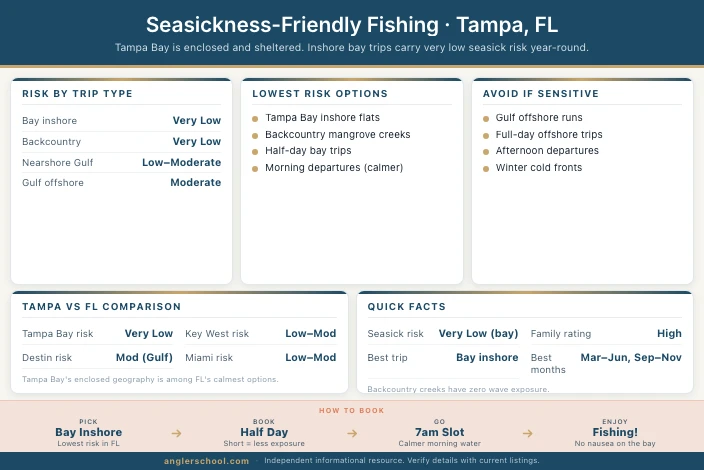
Most Florida seasickness concerns stem from exposure to ocean swell or Gulf chop. Tampa Bay eliminates both. The bay’s enclosed geography, nearly 400 square miles of water surrounded by land on three sides, blocks the wave fetch that generates swell. Wind creates surface chop on the bay, but it’s a fraction of what you’d experience in open Gulf water.
Compare Tampa Bay to the destinations where seasickness is a real problem: offshore in Destin, Key West, or Miami. Those markets require running into open ocean water that generates consistent motion. Tampa Bay inshore fishing requires none of that. The only scenario where Tampa Bay anglers face meaningful motion is on nearshore or offshore trips, which motion-sensitive anglers should simply avoid.
Clearwater and St. Petersburg share the same bay system and the same low seasickness risk. If Tampa’s private pricing doesn’t work for your group, those destinations fish the same water.
Trip Length Guidance
A half-day (4 to 5 hours) is the right format for motion-sensitive anglers. Shorter time on the water means less exposure time, and morning departures (7am) get you out and back before afternoon winds build on the bay surface.
Full-day bay trips (8 to 10 hours) are possible for anglers who’ve confirmed they handle bay conditions fine. If this is your first time on Tampa Bay and you have any motion sensitivity, start with a half-day. You can always book a longer trip on a follow-up visit once you know how you respond.
Avoid full-day nearshore or offshore trips entirely if seasickness is a concern. The bay is the safe zone.
Comfort Notes
Medication: Even on calm bay water, some motion-sensitive anglers benefit from a precautionary dose of Dramamine the night before. Non-drowsy versions (meclizine) are preferred, standard Dramamine can cause significant fatigue. Patches (scopolamine) are the most effective long-duration option but require a prescription. For a bay trip, over-the-counter meclizine the night before is usually sufficient.
Eating before the trip: Don’t board on an empty stomach. A light breakfast 1 to 2 hours before departure settles the stomach better than going out hungry. Avoid heavy or greasy food the night before.
On the boat: Stay in the middle of the boat, look at the horizon rather than down at the water or your phone, and keep moving slightly rather than sitting still. Fresh air helps, don’t go below deck if there is one.
Weather awareness: Even calm bay days can develop chop by midday in spring and summer. Morning departures keep you ahead of afternoon wind increases. Ask the captain about expected conditions when you book.
What to Expect
Arrive at the marina 15 to 20 minutes early. Let the captain know you have motion sensitivity, experienced captains adjust their approach, keeping the boat speed moderate and favoring spots with less surface disturbance if wind is up.
On a Tampa Bay inshore trip, the boat moves between spots in the bay. The captain reads the conditions and avoids areas with the most chop when wind is a factor. Fishing time is active, you’re casting and reeling, which keeps your focus on the task rather than on how you feel.
Redfish, trout, and snook are the main targets. Action comes regularly enough that you stay engaged rather than sitting idle (which makes motion sickness worse). Most motion-sensitive anglers are pleasantly surprised by how manageable a bay trip feels.
Example Scenarios
An angler who got sick on a whale-watching boat: She’d avoided boat trips ever since but wanted to try fishing. She took meclizine the night before a morning Tampa Bay inshore trip. The bay was flat. She caught trout and redfish and felt no discomfort throughout. The experience reset her expectation of what boat motion feels like.
A family with a 9-year-old who gets carsick: The parents were nervous about any boat trip. They booked a private half-day bay trip in May and confirmed with the captain that the whole trip would stay in the bay. No issues. The 9-year-old caught two fish and asked to go again.
A group of four adults, two of whom had gotten sick on a previous Key West trip: They’d been offshore and had a rough experience. They chose Tampa Bay specifically for the enclosed water. Private half-day, morning departure, bay only. All four had a normal, comfortable trip. The two who’d been sick before said the comparison to Key West offshore was completely different.
Book This Trip
- Browse Calm-Water Charters Opens booking platform
- Browse Activity Tours Opens tour booking platform
Frequently Asked Questions
- Is Tampa Bay really that much calmer than other Florida fishing spots?
- Yes. Tampa Bay is a large, enclosed estuary with no direct ocean or Gulf exposure. Swell and wave fetch that affect open-water destinations don’t reach the interior of the bay. The rough water risk rating for Tampa is low, the same as Clearwater and St. Pete, and significantly lower than offshore markets like Key West, Destin, or Miami.
- Should I take seasickness medication before a Tampa Bay trip?
- It’s a reasonable precaution for anyone with any history of motion sensitivity, even though the bay is calm. Take non-drowsy meclizine the night before, not the morning of, it works better with overnight absorption. If you have no history of motion issues and it’s a morning bay trip, medication is optional.
- Can I fish Tampa Bay if I've gotten sick on other Florida fishing trips?
- In most cases, yes. The bay environment is structurally different from open-water destinations. Getting sick on an offshore Destin trip or an Atlantic boat in Miami doesn’t predict your response to a flat, enclosed bay in Tampa. Talk to your captain, take precautionary medication, and start with a morning half-day to see how you respond.
- Are shared boats in Tampa good for seasick-prone anglers?
- Most Tampa shared boats run nearshore or offshore routes, not bay inshore. For motion-sensitive anglers, the private bay charter is the right format because it specifically stays in protected water. Shared boats at Tampa are not reliably the calm option.
More Trips in Tampa
Related pages for motion-sensitive anglers:
- Inshore vs Offshore for Families in Tampa: A direct comparison of bay vs Gulf trips and the motion difference between them.
- What to Book When It’s Windy in Tampa: How windy conditions affect bay trips specifically and what to do when conditions aren’t ideal.
- Family Fishing Charters in Tampa: How to plan a family trip that keeps everyone comfortable, including motion-sensitive kids.
- Best Beginner Fishing Charters in Tampa: First-timer guidance including how to manage uncertainty about seasickness on a first trip.
Related Guides
Deeper reading on the decisions this page covers:
Back to the Tampa fishing charters overview.