Best Fishing Charters for Teens in Tampa, FL
Who This Trip Is For
This page is for parents booking a charter for a teen, roughly ages 12 to 17, who wants a more challenging experience than a beginner inshore trip. Teens who’ve already fished Tampa Bay or any inshore fishery are ready for the backcountry, the tarpon run, or a nearshore king mackerel run.
It’s also useful if you have a teen who’s never fished from a boat but is confident, physically capable, and unlikely to be bored. Teens handle the longer format and more demanding species better than younger kids, which opens up more trip options.
Good Fit / Bad Fit
- Teens ages 12 and up targeting tarpon on a spring bay trip
- Experienced young anglers ready for backcountry snook and redfish in mangrove creeks
- Teens comfortable on boats for a nearshore king mackerel run
- Groups of 2 to 3 teens and parents where private pricing is split efficiently
- Any teen who wants to step up from a standard beginner inshore trip
- Teens who've never been on a boat and are prone to motion sickness
- start with a bay trip first
- Full-day offshore trips for teens who haven't built up sea legs yet
- December and January trips when the inshore bite slows
- Shared party boats where teens will be fishing alongside strangers without personalized attention
Budget Expectations
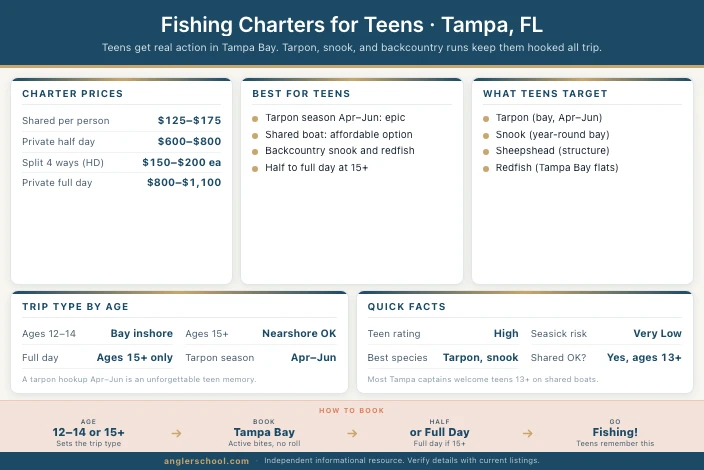
For teens who want a more targeted experience, tarpon, backcountry, or nearshore, private is the format to book. A private half-day at $600 to $800 split among two adults and two teens runs $150 to $200 per person, competitive with Tampa’s shared boat rate.
The full-day premium in Tampa is notably narrow: only $200 to $300 more than a half-day. If your teen wants to combine inshore morning fishing with a nearshore afternoon run, the price step-up is modest compared to most Florida destinations.
Trip Length Guidance
Most teens do well on a half-day trip and may want more when it ends, that’s the right outcome. Half-day bay and backcountry trips are productive and engaging, and the four- to five-hour format keeps things from getting stale.
A full day (8 to 10 hours) makes the most sense if the goal is the tarpon run or a nearshore-to-offshore combination. Full-day tarpon charters in Tampa during May allow for multiple shots at large fish over the course of the tide cycles. Teens who are physically capable and have some boat experience handle full days well.
Backcountry trips are typically structured as half-day trips. The shallow, technical nature of mangrove creek fishing is intense and concentrated, four hours in a tidal creek is usually enough to exhaust the best spots without needing to extend.
Comfort Notes
Motion concerns: Tampa Bay’s rough water risk is rated low. Teens who’ve been fine in cars and on smaller boats will likely have no issues with a bay or backcountry trip. A nearshore run adds some Gulf chop, give Dramamine the night before for any teen with a history of motion sensitivity.
Physical demands: Tarpon fishing is physically demanding. The fish are large (often 80 to 120 pounds in Tampa Bay), fast, and jump repeatedly after being hooked. Teens need to be strong enough to handle a heavy rod under pressure. Most captains who run tarpon trips will assess the angler and adjust the tackle accordingly.
Sun exposure: The Gulf Coast sun is intense from April through September. Long-sleeve UV shirts and hats are essential, especially for teens who tend to ignore sunscreen. Full-day trips mean 8 to 10 hours of sun exposure, pack enough for reapplication.
What to Expect
For a spring tarpon trip, expect a low and slow approach: the captain positions the boat in a bay channel or pass, and tarpon are either sighted or targeted by feel on specific tidal stages. The patience required is real, tarpon fishing involves more waiting than standard inshore fishing, but the payoff when a big fish takes the bait is unlike anything in Florida inshore fishing.
For a backcountry trip, the captain poles a flat-bottomed skiff into shallow mangrove creeks. Casting into tight structure, reading the water, and working lures or live bait around root systems requires focus and accuracy. Teens who’ve been fishing for a while find backcountry work engaging precisely because it’s technical.
Nearshore trips (king mackerel, Spanish mackerel) move at a faster pace and cover more water. Trolling or live-bait drifting over nearshore structure puts multiple species in range in a single trip.
Example Scenarios
A 15-year-old who’s done bay fishing before: His parents wanted to step up the experience. They booked a private half-day backcountry trip in October. The skiff poled into tidal creeks the teen had never seen, targeting snook in structure less than a foot deep. He caught three snook and said it was the most technical fishing he’d done.
Two teens, ages 13 and 16, with a parent: They wanted tarpon. They booked a private half-day bay trip in May, timed to the incoming tide in a known Tampa Bay channel. The 16-year-old hooked one, fought it for 20 minutes, and the tarpon jumped four times before throwing the hook. The 13-year-old had a brief hookup on a smaller fish. Neither one complained about not landing one, the fight was enough.
A family of four with a teen and a 9-year-old: They wanted a trip that worked for both ages. They booked a private half-day bay trip in April, bay inshore for the 9-year-old, with the understanding the captain would work some tarpon-adjacent structure for the teen. Both kids caught fish; the teen got more technical attention toward the end of the trip.
Book This Trip
- Browse Family Charters Opens booking platform
- Browse Activity Tours Opens tour booking platform
Frequently Asked Questions
- Can teens do a tarpon charter in Tampa Bay?
- Yes. Teens ages 12 and up are generally capable of handling tarpon tackle with some coaching from the captain. The fish are large and the fight is demanding, but a capable teen can absolutely participate. Confirm with the captain before booking that the trip style is appropriate for your teen’s experience level.
- What's the difference between a backcountry trip and a regular bay inshore trip in Tampa?
- Open-bay inshore fishing covers wider water, grass flats, channels, and open bay areas, targeting redfish, trout, and snook. Backcountry fishing means poling or motoring into shallow tidal creeks and mangrove systems, targeting snook and redfish in tight structure. Backcountry trips are more technical and typically use lighter gear. Teens who’ve already done a standard bay trip often find the backcountry style more engaging.
- Is the nearshore Gulf safe for teens who get a little seasick?
- Nearshore runs out of Tampa add moderate Gulf chop compared to the bay. If your teen has ever felt queasy on a boat, give Dramamine the night before a nearshore trip. For any teen with a real history of motion sickness, stay in the bay for the first trip and upgrade from there.
- When is the best time to book a teen fishing charter in Tampa?
- Spring (April through June) for tarpon is the standout window for older teens. Fall (September through November) is excellent for backcountry snook and redfish with less tourist pressure. Avoid December and January, when inshore species activity drops significantly.
More Trips in Tampa
Compare related options before you book:
- Family Fishing Charters in Tampa: How to plan a trip that works when your group includes both younger kids and teens.
- Best Fishing Charters for Kids in Tampa: Guidance for younger children who aren’t quite ready for the backcountry or tarpon.
- Inshore vs Offshore for Families in Tampa: The tradeoffs between bay fishing and Gulf runs when you have a mixed-age group.
- Best Half-Day Fishing Charters in Tampa: More detail on what a 4- to 5-hour trip covers and when the format is the right call.
Related Guides
Deeper reading on the decisions this page covers:
Back to the Tampa fishing charters overview.