What to Book When It's Windy in St. Petersburg, FL
Who This Trip Is For
This page is for travelers who’ve checked the forecast and seen wind, or who’ve had a trip postponed or ruined by weather at another destination. It explains why St. Pete’s inshore zones handle wind much better than most Florida fishing areas and what to book when conditions look marginal.
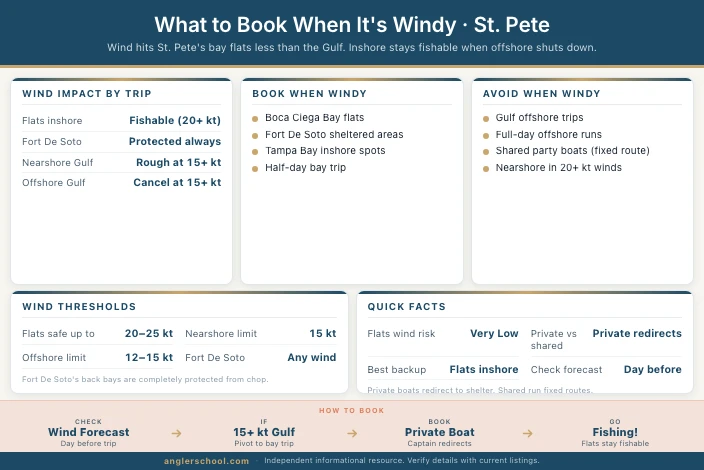
Understanding the geography is the key insight. St. Pete’s best fishing isn’t on the open Gulf. It’s inside a protected bay system that wind rarely affects.
Good Fit / Bad Fit
- Any group whose trip day shows wind in the forecast. Inshore flats stay fishable
- Groups who had an offshore trip canceled and want a same-day alternative
- Families with kids who can't afford a wasted day . the flats provide a reliable backup
- Anyone who prefers not to cancel or reschedule a charter
- Anglers who specifically want sight-fishing on the flats where wind direction matters less than in open water
- Groups who specifically need offshore grouper or snapper. Those trips get canceled by wind
- Anyone booking nearshore and hoping wind is manageable . 15+ knot days make nearshore uncomfortable even if conditions technically allow it
- Travelers who only care about offshore species and won't substitute inshore alternatives
Budget Expectations
Inshore flats trips in St. Pete cost the same regardless of wind conditions outside. A private half-day flats trip at $550 to $800 is the recommended booking when wind is in the forecast. Private gives you routing control. The captain stays in protected water rather than attempting a nearshore run that conditions don’t support.
Shared party boats may attempt nearshore runs on borderline wind days or may cancel entirely. A private inshore booking is the most weather-resilient option in St. Pete’s charter market.
Why St. Pete’s Flats Handle Wind
The Fort De Soto area sits inside a chain of barrier islands, Mullet Key, Tierra Verde, and the surrounding sand keys,that block Gulf swell from reaching the inner bay. Boca Ciega Bay is an enclosed tidal bay with no direct Gulf exposure. Both zones have water depths of 1 to 4 feet in the primary fishing areas.
When wind hits from the west or southwest, it generates chop on the open Gulf. That chop gets broken up or stopped entirely by the barrier islands before it reaches Fort De Soto or Boca Ciega Bay. Wind creates ripples on the flats, not waves. A boat fishing the flats in 15 knots of wind is in conditions that most anglers wouldn’t notice.
Contrast that with a boat 5 to 10 miles offshore in the Gulf during the same 15-knot breeze. The fetch, open water for wind to build wave height,is unlimited. Conditions there are genuinely uncomfortable.
Trip Length Guidance
On a windy day, a half-day morning trip (4 to 5 hours) is the right call. Wind typically builds through the morning and peaks in the early afternoon. Starting at 7am gives you the calmer portion of the day even on a windy forecast.
Avoid afternoon trips on days when the wind forecast shows sustained 15+ knots. Afternoon conditions will be worse than morning, and the flat water advantage erodes as the day goes on.
Full-day trips on windy days are harder to justify. By the second half of the day, even the protected flats can have some chop, and the remaining time doesn’t justify the full-day cost. Half-day morning is the practical wind-day trip format.
Comfort Notes
On the flats in a breeze, the main comfort change is temperature. Wind accelerates evaporation from wet skin and makes the air feel cooler than the temperature reading. A 78-degree morning with 15 knots of wind feels colder than it sounds, especially on the boat. Pack a light windbreaker or shell layer for the first part of the trip.
Fishing accuracy takes more focus in wind. Casts get pushed off target. A good captain will position the boat so the wind helps rather than hinders the cast angle. For beginners, wind adds a level of difficulty but the captain accounts for it in the positioning.
The calmer the water, the better the visibility for sight-fishing. On a moderate wind day, surface ripples reduce the ability to spot fish before casting. Captains adjust by using different fishing techniques. Working channel edges, poling with the sun angle to improve light penetration, or switching to bottom rigs near structure rather than sight-casting on the flat.
What to Expect
The captain will assess conditions before and during the trip. On a private charter, if conditions at the first planned flat are unworkable, the captain routes to a more sheltered zone. St. Pete’s bay system has enough geography that there’s almost always a fishable location within reach.
A typical windy-day flats trip might shift from open Boca Ciega Bay flats to a more enclosed section of the bay, or to the lee side of Fort De Soto where the barrier island blocks the direct wind. The species don’t change. Redfish, trout, and flounder are active regardless of surface conditions.
If conditions are genuinely dangerous, sustained winds above 25 to 30 knots with rough bay conditions,most captains will cancel and reschedule. This is rare for St. Pete’s protected inshore zones, but it happens. A good captain prioritizes safety over a stubborn departure.
Example Scenarios
A family with a trip booked on a forecast-winds day: They were nervous about a 15-knot forecast. Their captain told them inshore flats would be fine and they launched on schedule. The bay was slightly choppy but easily manageable. They caught fish and the kids never noticed the wind except as a pleasant breeze.
A solo angler whose nearshore trip got cancelled: He switched to a private inshore flats booking on the same day. He’d wanted snapper but ended up with redfish and trout in conditions that were better than any nearshore trip could have offered that day.
A group who’d had a trip cancelled in Destin by weather: They specifically chose St. Pete for their next fishing vacation because of the protected water reputation. On their trip morning, the Gulf was rough and the offshore boats were staying in. Their flats trip launched on schedule.
Book This Trip
- Browse Calm-Water Charters Opens booking platform
Frequently Asked Questions
- How much wind is too much for an inshore flats trip at St. Pete?
- Most captains fish the Fort De Soto flats comfortably in winds up to 15 to 20 knots. Above 20 to 25 knots, bay conditions become choppier and sight-fishing quality degrades. Sustained winds above 25 to 30 knots may push captains to cancel even inshore trips. “Wind tide”, strong easterly winds in fall and winter pushing water off the shallow flats,is a separate concern that captains monitor.
- Will a captain cancel my trip if it's windy?
- Rarely, for inshore flats trips. Captains at St. Pete are accustomed to fishing in moderate wind because the protected zones make it manageable. Nearshore and offshore captains are more likely to cancel in wind because Gulf conditions change more dramatically. Private inshore charters are the most wind-resilient booking type at St. Pete.
- What species are still catchable on a windy day in St. Pete?
- Redfish, trout, and flounder remain catchable in the protected flats regardless of wind. Redfish in particular are aggressive feeders in choppy water and often bite well in a breeze. The sight-fishing quality goes down in wind (surface ripple reduces visibility) but the fishing doesn’t stop.
- Is there a difference between "windy" at St. Pete and "windy" at a Panhandle destination?
- Yes, significantly. Panhandle destinations like Destin and Panama City Beach fish primarily in the Gulf of Mexico, where 15+ knot winds often cancel trips entirely. St. Pete’s primary fishing is inside protected bay systems where the same wind forecast produces only rippled water. This is why St. Pete (and Tampa Bay generally) has a much lower rough-water risk rating than Panhandle destinations.
More Trips in St. Petersburg
Other pages relevant to conditions planning:
- Seasickness-Friendly Fishing Trips in St. Petersburg: Why the same geography that handles wind also eliminates seasickness risk.
- Inshore vs Offshore for Families in St. Petersburg: The full comparison of protected inshore fishing vs Gulf trips for families.
- Best Half-Day Fishing Charters in St. Petersburg: Why a morning half-day is the optimal format on any day, especially when wind is building.
- Family Fishing Charters in St. Petersburg: How the protected flats make St. Pete a reliable family fishing destination year-round.
Related Guides
Deeper reading on the decisions this page covers:
- What Happens If Weather Cancels Your Fishing Charter?
- Fishing Charter Cancellation Policies Explained
Back to the St. Petersburg fishing charters overview.