Seasickness-Friendly Fishing Trips in St. Petersburg, FL
Who This Trip Is For
This page is for travelers who get seasick on boats and aren’t sure whether a fishing charter is a realistic option, or who’ve had bad experiences on offshore trips and want to know if inshore fishing is genuinely different.
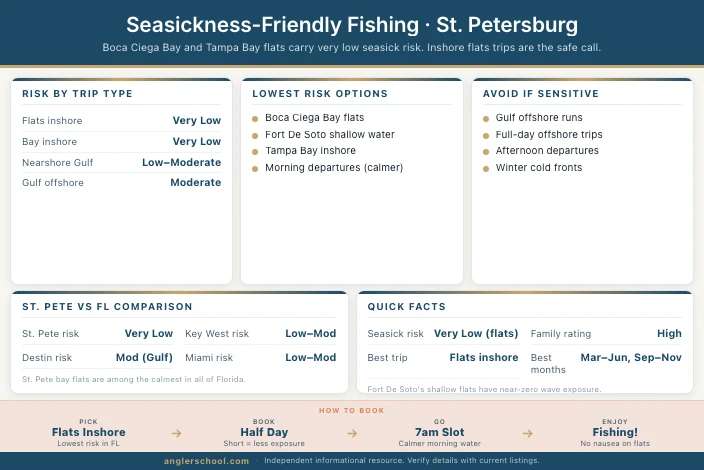
St. Pete’s geography provides a real answer. The Fort De Soto area and Boca Ciega Bay are enclosed by barrier islands on the west and by shallow water on every side. Ocean swell can’t penetrate. What happens on the Gulf on a given day has almost no effect on what happens at Fort De Soto.
Good Fit / Bad Fit
- Anyone with a history of motion sickness who wants to try fishing in a controlled environment
- Families with kids who get carsick and need calm water
- First-timers nervous about seasickness after a bad offshore experience elsewhere
- Anyone targeting flats species
- redfish
- trout
- flounder
- where the fishing quality matches the calm conditions
- Anglers who want to fish without taking medication as a precaution
- Anyone who specifically wants offshore grouper or snapper. Those trips go into the Gulf where motion is a real factor
- Travelers who need deep-sea or blue-water fishing . that experience isn't compatible with low seasickness risk
- Groups booking nearshore Gulf trips and expecting the same calm conditions as inshore
- Anyone who books in rough Gulf weather and doesn't specify inshore routing with their captain
Budget Expectations
A private half-day flats trip at $550 to $800 is the best seasickness-avoidance option. You get direct control over routing. The captain stays in protected water the entire time. Shared party boats can’t offer that guarantee; they run fixed routes that sometimes include nearshore Gulf segments.
At four to five people, private at $110 to $160 per person matches or beats the shared rate of $125 to $175. For anyone with seasickness concerns, the routing control of a private charter is worth the comparable cost.
What Makes St. Pete’s Flats Different
The Fort De Soto flats and Boca Ciega Bay are sheltered by a chain of barrier islands and by shallow water depths throughout the fishing zones. Water depths in the primary flats range from 1 to 4 feet. Even when Gulf conditions produce 2 to 3-foot seas outside the passes, the water inside Fort De Soto stays flat.
Compare this to nearshore or offshore trips, where the boat travels beyond the barrier island protection into open Gulf water. At 1 to 2 miles offshore in a building sea, a 20-foot center console produces real motion. At the Fort De Soto flats, those conditions are irrelevant.
Trip Length Guidance
A half-day morning trip (4 to 5 hours) is the right call for motion-sensitive anglers. Morning trips happen before the Gulf chop builds during the day, and a shorter trip reduces total exposure time. Finishing before noon also avoids the afternoon heat, which amplifies seasickness symptoms.
Avoid full-day trips if seasickness is a genuine concern. Longer exposure to boat motion, even minimal motion on the flats,can become a problem over 8 to 10 hours. If you have a positive half-day experience, full-day becomes a realistic option on the next trip.
Comfort Notes
Before the trip:
- If you have any history of motion sickness, take Dramamine or a comparable medication the night before. Starting it the morning of the trip is too late for it to work effectively.
- Eat a light, non-greasy meal before the trip. An empty stomach and a full stomach are both risks. A moderate meal an hour before departure is ideal.
- Get enough sleep. Fatigue amplifies motion sensitivity.
On the trip:
- Focus on the horizon or a distant fixed point if you feel unsettled
- Stay near the center of the boat where motion is minimal
- Avoid reading or looking at your phone
- The early-morning air on the flats is usually cool and clean. This helps significantly
What to tell the captain: Be upfront about seasickness concerns when you book. A captain who knows your group includes someone motion-sensitive will keep the routing inside protected water and avoid running through choppy passages. Captains would far rather know in advance than deal with a sick passenger mid-trip.
What to Expect
The boat launches from a dock near Fort De Soto or on Boca Ciega Bay and runs 10 to 20 minutes to the first flat. Boat speeds while transiting are moderate and the water is sheltered. This is the lowest-motion transit you can have on a Florida fishing charter.
On the flat, the boat either poles slowly or sits anchored near a productive zone. The boat’s movement while fishing is minimal. If conditions are good and fish are feeding, you’re standing on a nearly still boat in shallow, flat water, casting to targets you can see.
At no point on a Fort De Soto or Boca Ciega Bay flats trip does the boat enter open Gulf water unless the captain specifically routes offshore. For seasickness-sensitive groups, that routing boundary is the entire point.
Example Scenarios
A parent who got seasick on a whale-watch cruise: She was nervous about any boat trip. A flats charter in Boca Ciega Bay was the recommendation. She took Dramamine the night before. The boat was nearly still the entire morning. She caught a redfish and a trout and spent the rest of the week raving about it.
A family of four with two kids who get carsick: They chose St. Pete specifically because of the low seasickness risk. Both kids handled the morning flats trip without incident. No waves, no drama. Their only challenge was keeping sunscreen applied. Both wanted to go again the next morning.
A first-timer who had given up on boat trips: He’d been offshore twice at other destinations and been sick both times. He booked an inshore flats trip as a last attempt. No medication, no problems. He fished the Fort De Soto flats for four hours and understood for the first time that his problem had been the water conditions, not the fishing.
Book This Trip
- Browse Calm-Water Charters Opens booking platform
Frequently Asked Questions
- Is St. Pete truly low seasickness risk or is that just marketing?
- The geography is real. The Fort De Soto flats and Boca Ciega Bay are enclosed by barrier islands and shallow water. Ocean swell cannot penetrate these zones. The rating of low seasickness risk reflects the actual water conditions, not a sales pitch. The one caveat: if you book a nearshore or offshore trip instead of an inshore trip, you go outside the barrier island protection and conditions change significantly.
- Should I still take Dramamine for a St. Pete flats trip?
- If you have any history of motion sickness, yes. The flats are calm, but erring on the side of preparation is reasonable. Take it the night before. By morning-of is too late for maximum effectiveness. If the flats trip goes smoothly with the medication, you can skip it on the next trip.
- What if conditions are rough the day of my trip. Can I change to an inshore option?
- If you’ve already booked a private flats or bay trip, your routing is inshore by design. Gulf conditions don’t affect your trip. If you’re on a shared party boat scheduled for a nearshore run, the captain may adjust the route in severe weather but has less flexibility. Another reason private is the better choice for motion-sensitive anglers.
- Are there other low-seasickness destinations near St. Pete?
- Yes. Tampa Bay inshore and backcountry trips are similarly protected. Clearwater offers calm inshore options as well, with lower shared rates. Naples has extremely calm inshore and backcountry fishing to the south. All four destinations share a low seasickness risk rating. St. Pete’s specific advantage is the Fort De Soto flats, which offer sight-fishing quality that most other calm-water destinations don’t match.
More Trips in St. Petersburg
Related options for calm-water fishing:
- What to Book When It’s Windy in St. Petersburg: How St. Pete’s protected zones handle bad weather days.
- Family Fishing Charters in St. Petersburg: Broader family guidance including comfort notes and calm-water trip planning.
- Best Beginner Fishing Charters in St. Petersburg: First-timer guidance that covers the same protected inshore zones.
- Inshore vs Offshore for Families in St. Petersburg: The full comparison of calm inshore flats vs Gulf trips.
Related Guides
Deeper reading on the decisions this page covers:
Back to the St. Petersburg fishing charters overview.