Inshore vs Offshore for Families in St. Petersburg, FL
Who This Trip Is For
This page is for families deciding between inshore flats fishing and an offshore Gulf trip when booking a St. Pete charter. It lays out the practical tradeoffs, water conditions, species, cost, and trip length,so you can make the right call for your specific group.
The inshore vs offshore decision at St. Pete has a clearer answer than at most Florida destinations. St. Pete’s inshore fishing is exceptionally good. Its offshore fishing requires more time and more motion than a family trip usually warrants.
Good Fit / Bad Fit
- Families with kids under 12 who will do far better on calm inshore flats
- Groups where anyone is susceptible to seasickness. Inshore eliminates the risk
- Families in spring who want tarpon near the bay passes without going offshore
- Groups on a budget where a half-day inshore trip keeps costs significantly lower than a full-day offshore run
- Families who want the sight-fishing experience unique to St. Pete's flats
- Families with older teens who specifically want grouper or snapper and are ready for heavier tackle
- Groups where no one gets seasick and everyone wants the offshore experience
- Anyone who needs the full-day offshore species list as the primary goal of the trip
- Families booking in peak summer who plan an afternoon offshore departure. Afternoon storm risk makes offshore timing difficult
Budget Expectations
The cost difference between inshore and offshore at St. Pete is significant.
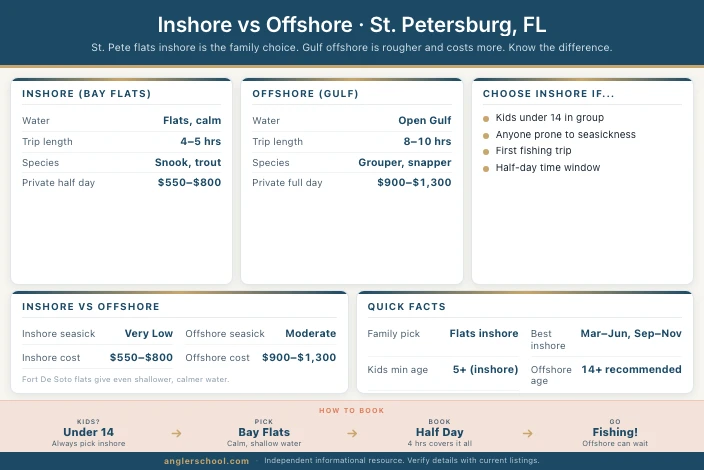
A private half-day inshore or flats trip costs $550 to $800 for the whole boat. Offshore trips require a full day ($900 to $1,300) due to the run time to productive Gulf structure. The full-day premium of $350 to $500 is meaningful. For families who could have a complete, satisfying inshore trip in half the time and at lower cost, the offshore upgrade rarely makes sense.
At four to five people splitting a private half-day inshore trip, the per-person cost runs $110 to $200. An offshore full-day at the same group size runs $150 to $260 per person. More cost, more time on the water, and rougher conditions. The math consistently favors inshore for family groups.
Trip Length Guidance
Inshore flats trips in St. Pete work on a half-day (4 to 5 hours). The productive zones are close to the dock. You don’t need extra time to get there, and four hours is enough to fish multiple flats and catch fish.
Offshore trips to Gulf structure require a full day (8 to 10 hours). The run from most St. Pete launch points to quality bottom structure takes 45 minutes to an hour or more each way. Add that to actual fishing time and you need a full day. This also means more time in motion, boat ride out, boat ride back,which is hard on younger kids.
For families with children under 10, the inshore half-day is almost always the right answer. The offshore full day is appropriate for older teens with some charter experience who specifically want the different species and experience.
Comfort Notes
Inshore flats: Calm water, minimal wave action, low seasickness risk. Kids can look over the side of the boat and see fish in the water. The sight-fishing component keeps young anglers engaged. Temperatures can be hot. Schedule morning trips and bring sun protection.
Offshore Gulf: Variable water conditions depending on weather. Even on calm days, a 45+ minute run at speed has motion. Anyone with any seasickness sensitivity should stay inshore. Heavier tackle, deeper targets, less visual involvement. Exciting for the right audience; uncomfortable for the wrong one.
Regardless of which option you choose, rods, bait, and tackle are included on most private charters. Bring sun protection, light snacks, and water for the whole group.
What to Expect
On an inshore flats trip: The boat runs 10 to 20 minutes to the first flat. The captain scans for fish and starts working grass beds and sandy transitions. Visual, active fishing. Kids can see redfish moving, cast to specific targets, and watch the fight happen in clear, shallow water. The trip moves across two to three spots in four to five hours.
On an offshore trip: The boat runs 45 minutes to an hour or more offshore, reaching structured bottom where grouper and snapper hold. You anchor or drift, drop rigs to the bottom, and wait for bites. Faster rod action when fish are active, but more sedentary fishing style between bites. The boat is moving in Gulf swell for the entire transit time each way.
Example Scenarios
A family of four, kids ages 6 and 9: They were debating going offshore to chase grouper after a trip to another Florida destination where they’d caught some. Their captain strongly recommended the Fort De Soto flats for the 6-year-old. They went inshore and the 6-year-old spotted and caught a redfish. The 9-year-old landed a flounder. No seasickness, no long run, back at the dock by noon.
A family of four with teen kids, ages 14 and 16: The teens had fished from boats before and wanted grouper. The parents were fine with a longer trip. They went full-day offshore, caught red snapper and grouper, and the teens handled the tackle confidently. The parents experienced some motion on the Gulf run but managed it.
A couple with one 11-year-old: They were torn. The 11-year-old had never been offshore and they weren’t sure how he’d handle it. They started with a half-day inshore flats trip. He handled it well and asked about going offshore next time. They’re planning a nearshore snapper trip for the following visit. A logical intermediate step.
Book This Trip
- Browse Family Charters Opens booking platform
Frequently Asked Questions
- Is inshore or offshore better for families with young kids in St. Pete?
- Inshore, without question for kids under 12. Calm protected water, close to the dock, shorter trip, and sight-fishing that keeps young kids engaged. The Fort De Soto flats are among Florida’s best inshore family options. Offshore adds run time, cost, and wave exposure that most families with young kids don’t need.
- What species can families catch inshore at St. Pete?
- Redfish, trout, and flounder are the primary flats targets. Snook are present in warmer months. Tarpon move through the bay passes in April and May. All three flats species are visual, active, and appropriately challenging for families. Flounder is a standout that most neighboring destinations don’t list as a primary inshore target.
- Are nearshore trips a middle ground between inshore and offshore?
- Yes. Nearshore trips run 5 to 15 miles into the Gulf and target snapper, grouper, and mackerel in shallower Gulf structure. The wave exposure is more than inshore but less than true offshore. Nearshore is a reasonable option for families with teens who want to step up from inshore without committing to a full-day offshore run. A half-day nearshore trip is feasible.
- How far offshore do St. Pete charters typically run for grouper?
- Quality grouper structure is typically 20 to 40 miles offshore from the St. Pete area. The run alone takes 45 minutes to well over an hour each way. That transit time is why offshore trips require a full day. Nearshore trips run much shorter distances and work better for families who want to try something different without the extended time commitment.
More Trips in St. Petersburg
Need a different angle on this decision?
- Family Fishing Charters in St. Petersburg: Full overview of what St. Pete family trips look like, with budget math and age guidance.
- Best Fishing Charters for Kids in St. Petersburg: Focused on younger children who will fish the inshore flats.
- Best Fishing Charters for Teens in St. Petersburg: Teens who are ready for nearshore or a targeted offshore run.
- Seasickness-Friendly Fishing Trips in St. Petersburg: If motion sensitivity is the deciding factor, this covers St. Pete’s best calm-water options.
Related Guides
Deeper reading on the decisions this page covers:
Back to the St. Petersburg fishing charters overview.