Seasickness-Friendly Fishing Trips in Miami: What to Book and How to Prepare
Who This Trip Is For
This page is for people who have gotten sick on a boat before, who get carsick, or who are genuinely nervous that seasickness will ruin an expensive trip. It’s also for groups where one person is motion-sensitive and the rest aren’t, and you need a trip that works for everyone.
Miami gives you real calm-water options that don’t require choosing between fishing and comfort. Biscayne Bay and the Everglades are the answer. Neither requires any offshore Atlantic exposure.
Good Fit / Bad Fit
- Private Biscayne Bay half-day trips with protected water throughout
- Everglades backcountry trips in shielded mangrove channels
- Half-day morning trips before sea breeze builds and conditions shift
- Trips in December through April when Atlantic conditions are typically more stable
- Taking prescription or OTC medication the night before and morning of the trip
- Atlantic offshore or reef trips
- real swells
- real motion
- no shelter
- Full-day trips for first-time offshore anglers who haven't confirmed their tolerance
- Shared party boats
- most run offshore and reef routes
- no flexibility to bail
- August and September bookings when Atlantic conditions are worst
- Skipping medication because you feel fine at home
Budget Expectations
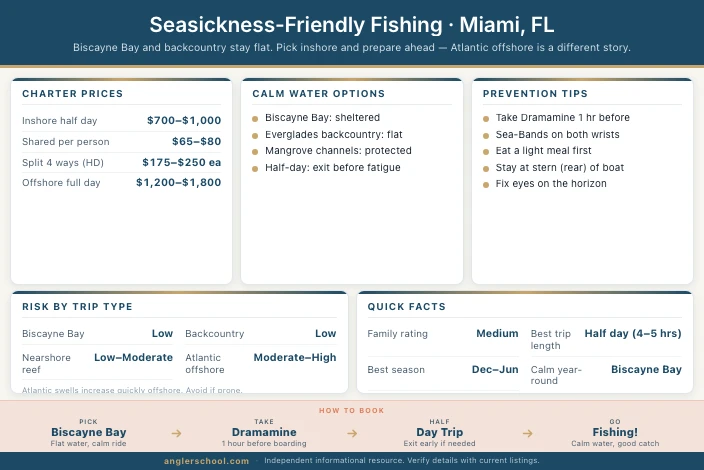
Seasickness-safe trips in Miami are private charters. Shared boats don’t run Biscayne Bay or Everglades routes, which are the calm-water alternatives.
A private half-day Biscayne Bay trip typically falls in the lower end of the half-day range because bay boats are smaller than offshore sportfishers. Split among four people, the per-head cost runs $175 to $250. That’s the realistic cost of a Miami fishing morning that keeps you in protected water the entire time.
The Everglades backcountry requires a longer transfer to reach from Miami and may run closer to the full-day rate depending on the guide. Ask when you book how long the run takes and whether it’s more appropriate as a full-day commitment.
Trip Length Guidance
A half-day (4 to 5 hours) is the safest length for anyone prone to seasickness, even on calm Biscayne Bay water. Fatigue and dehydration both worsen nausea, and they accumulate faster on the water than on land. Ending the trip before you hit those thresholds is easier than managing them once they’ve set in.
Morning departures give you calmer conditions. Sea breeze in Miami builds through the afternoon, which increases surface chop even in the Bay. A 7am departure gets you the most stable water and the coolest temperatures.
If you’ve done a Bay half-day and handled it comfortably, you can consider moving to longer trips or different water on future visits. Use the first trip as a test.
Comfort Notes
Medication options:
- Dimenhydrinate (Dramamine): Over-the-counter, widely available, causes drowsiness in some people. Take the night before and again the morning of your trip.
- Meclizine (Bonine): Also OTC. Tends to cause less drowsiness than Dramamine. Take 12 hours before boarding for best effect.
- Scopolamine patch: Prescription only, applied behind the ear the evening before. Most effective for people with a documented history of severe motion sickness. Requires a doctor visit.
- Ginger: Ginger chews or capsules have a modest anti-nausea effect. Useful as a supplement to medication, not a substitute.
Sea-Bands (acupressure wristbands) work for some people and do nothing for others. They’re inexpensive and harmless, so they’re worth trying alongside medication.
On the boat:
- Stay toward the stern (back) rather than the bow. The bow gets more vertical motion on any chop.
- Stay outside and watch the horizon. Below-deck spaces concentrate engine fumes and remove visual reference points.
- Avoid looking at your phone or reading. Fixed-focus tasks worsen disorientation.
- Drink water steadily throughout the trip.
If you start feeling sick: Tell the captain immediately. On a private charter, the captain has options, changing route, slowing down, or returning to the dock. Acting early gives more options. Waiting until you’re fully sick gives fewer.
What to Expect
On a Biscayne Bay trip, the boat runs through the protected Bay system at low speed, moving between spots in shallow water with mangroves on either side. There’s almost no wave exposure. The sensation is closer to a slow ride on a lake than anything you’d associate with “ocean fishing.” For most motion-sensitive people, the Bay presents no problem at all.
In the Everglades backcountry, the captain poles or motors quietly through mangrove channels that block wind entirely. The water is shallow and the environment is still. It’s genuinely calm in conditions that would make offshore trips miserable.
If you’re determined to try offshore despite motion sensitivity, book the nearshore reef (not deep offshore) and take prescription medication. Sit at the stern, eat before you board, and don’t read anything during the trip. The nearshore reef involves less time in open water than a sailfish or tuna run. It’s still a real risk, but it’s the most conservative offshore option available.
Example Scenarios
A nervous first-timer who always gets carsick: She books a private half-day Biscayne Bay trip in April. She takes Bonine the night before. Morning departure at 7am. The boat stays in calm Bay water for the entire trip. No significant motion. She catches snapper and a small tarpon. She feels fine throughout and is already looking at a longer Bay trip for next year.
A couple where one person is seasick-prone and the other isn’t: He wants offshore. She knows she can’t handle open water. They book a private half-day Biscayne Bay trip as a compromise. He is mildly disappointed about not going offshore, but both enjoy the trip. She has no issues. They agree next year they’ll try the nearshore reef if she handles the Bay well.
A group of four where one person has severe motion sickness: The group originally wanted sailfish. One person has a scopolamine prescription. They book a full-day offshore sailfish trip in January, the seasick-prone angler uses the patch plus Bonine, sits at the stern, and stays focused on the horizon. He manages the full day without incident and catches two sails. He says it was worth preparing properly rather than skipping the trip.
Book This Trip
- Browse Calm-Water Charters Opens booking platform
- Browse Activity Tours Opens tour booking platform
Frequently Asked Questions
- How rough is Miami's offshore fishing water compared to Gulf Coast destinations?
- Meaningfully rougher on an average day. Miami sits on the Atlantic, which builds swells more freely than the Gulf of Mexico. Destin, Clearwater, and Tampa have Gulf offshore exposure that is generally calmer. Miami’s offshore is comparable to Fort Lauderdale and Palm Beach, moderate-to-rough Atlantic conditions that are noticeably harder on motion-sensitive passengers. The Bay is Miami’s answer to the Gulf’s calmer inshore water.
- Can I still go offshore in Miami if I get seasick, or should I just stay on the Bay?
- You can try offshore with proper medication, but it’s a real risk. Bonine or Dramamine helps most people manage mild to moderate motion sickness on the nearshore reef. For deep offshore sailfish or tuna trips, prescription scopolamine is the most effective option for people with a documented history. Don’t try offshore on your first Miami trip if seasickness is a serious concern. Prove the Bay to yourself first.
- Is the Everglades backcountry better or worse for seasickness than Biscayne Bay?
- Equally good or better. The Everglades backcountry channels are shielded by mangroves on all sides, which blocks wind and chop entirely. The water is shallow and calm even when the Bay has some surface movement. The trade-off is that it takes longer to reach from Miami marinas. If you have extra time and want the most protected environment possible, the Everglades is a strong choice.
- What should I tell the captain about my seasickness concerns?
- Tell them when you book, not the day of the trip. A captain who knows upfront can plan a route that avoids any exposed water, choose a departure time based on tidal conditions, and keep a bucket accessible without drawing attention to it. Most captains appreciate the heads-up and have dealt with motion-sensitive passengers many times.
More Trips in Miami
These pages cover related situations worth reading:
- What to Book When It’s Windy in Miami: Wind raises chop and seasickness risk together. This page covers how to handle a rough forecast.
- Inshore vs Offshore for Families in Miami: Clarifies exactly what the water is like in each environment and when inshore is the right call.
- Best Half-Day Fishing Charters in Miami: Shorter trips reduce seasickness risk by limiting time on the water.
- Family Fishing Charters in Miami: If the group includes kids, this page covers the full picture of trip type and comfort.
Related Guides
Deeper reading on the decisions this page covers:
Back to the Miami fishing charters overview.