Inshore vs Offshore Fishing in Miami for Families: How to Choose
Who This Trip Is For
This page is for parents trying to decide between an inshore Biscayne Bay trip and an offshore trip for their family. It’s most useful if someone in the group has motion sickness concerns, if your kids are under 13, or if you’re unsure how long the boat will be in open water on an “offshore” trip.
Miami makes this comparison sharper than most Florida destinations because the offshore exposure here is genuinely rougher than what you’d find on the Gulf coast. This isn’t the same question as asking “inshore vs offshore” in Clearwater or Tampa.
Good Fit / Bad Fit
- Biscayne Bay inshore trips for all families with kids ages 6 to 12
- Inshore when anyone in the group is prone to motion sickness
- Families who want a flexible schedule and the option to cut the trip short
- Kids seeing fishing from a boat for the first time
- Everglades backcountry for families wanting a different environment and species mix
- Atlantic offshore for families with kids under 13
- real swells
- long runs
- high motion risk
- Offshore for anyone who hasn't fished in open ocean before
- Full-day offshore trips when kids are the reason you're on the water
- Shared offshore party boats when you have young children and can't adjust the schedule
- Nearshore reef trips for kids under 8
- even mild Atlantic chop is hard on young kids
Budget Expectations
The price structure is the same whether you book inshore or offshore. The category of boat, private or shared, matters more than the zone you fish.
There’s an important note on shared boats: they don’t go to Biscayne Bay. If inshore is your choice for family reasons, you’re booking a private charter. A private half-day split among a family of four runs $175 to $250 per person. For most families, that cost is worth it given the experience difference and the route flexibility.
Inshore vs Offshore: The Key Differences
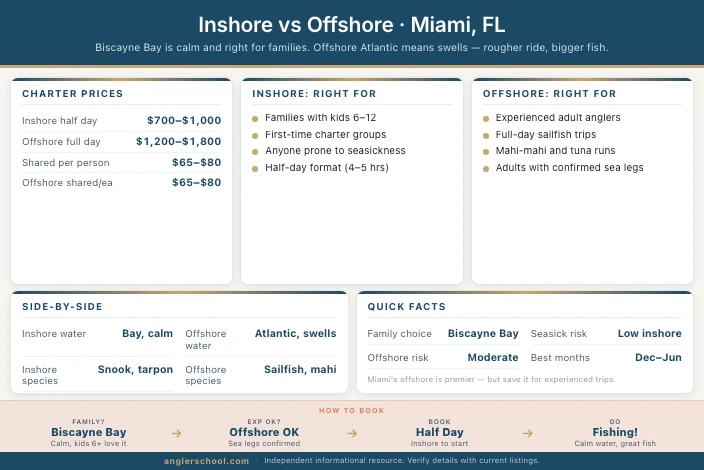
| Factor | Biscayne Bay (Inshore) | Atlantic Offshore |
|---|---|---|
| Water conditions | Protected, usually calm | Open ocean, real swells |
| Travel time to fishing | 10 to 20 minutes | 30 to 60+ minutes |
| Seasickness risk | Low | Moderate to high |
| Species | Snook, tarpon, snapper, jack | Sailfish, mahi-mahi, tuna, wahoo |
| Best for kids | Ages 6 and up | Teens with sea experience |
| Trip length | Half-day works well | Full-day usually required |
| Private vs shared | Private only | Both available |
Trip Length Guidance
For inshore Biscayne Bay trips with families, a half-day (4 to 5 hours) is almost always the right choice. The Bay fishing is productive in the morning hours, and getting home before the afternoon heat and fatigue compound makes for a better experience all around.
Offshore trips work on a different timeline. To reach sailfish or deep-water species, the boat runs 45 minutes to an hour each way. A half-day offshore trip barely gets you to the fish before you have to turn back. Full-day offshore is the minimum viable commitment. That’s 8 to 10 hours in the Atlantic, which is genuinely demanding for kids and adults alike.
If your family has teens who have fished from a boat before and want to try offshore, a full-day nearshore reef trip (shorter run, less exposure than deep offshore) is a reasonable bridge. It’s still more exposure than the Bay, but it’s not the 50-mile run that deep offshore requires.
Comfort Notes
Minimum age: The typical minimum for Miami charters is 6 years old. This applies to both inshore and offshore trips. Some captains set the bar higher for offshore boats. Confirm when you book.
Motion sickness on offshore: Miami’s Atlantic offshore is rated moderate for seasickness, but “moderate” undersells the reality of a full-day run in open water. Anyone who has ever gotten carsick should take medication before any offshore trip and should seriously consider whether inshore is a better choice.
Motion sickness on inshore: Biscayne Bay trips have very low seasickness risk. The water is sheltered, the boat moves slowly, and conditions rarely produce meaningful wave action. If your group includes motion-sensitive passengers, the Bay is the right environment.
Shade: Inshore bay boats have limited shade. Offshore center-consoles and sportfishers often have more cabin space. For kids spending a morning on the Bay, bring hats, long sleeves, and reef-safe sunscreen.
What to Expect
On a Biscayne Bay family trip, the boat works the bay shoreline, grass flats, and channel edges. The captain moves quietly between spots and guides casting. Kids see visible fish, get frequent bites, and stay engaged more consistently than they would waiting for a rod to bend on an offshore anchor.
On an offshore trip, the experience is different. The boat runs at speed for 30 to 60 minutes to reach the grounds. Then the captain sets lines and trolls or anchors up. There are quieter stretches between bites. Kids who haven’t fished offshore before often underestimate how much of the trip is waiting.
Example Scenarios
A family of four (kids ages 8 and 11) visiting Miami in April: They want to fish but aren’t sure about offshore. Parents book a private half-day Biscayne Bay trip. Kids catch snapper and a small tarpon. The 8-year-old stays engaged the full four hours. Both kids ask to come back. Parents are relieved they didn’t book offshore.
Two parents and a 15-year-old son who fished in freshwater but never offshore: They book a private full-day nearshore reef trip. The son is stoked. The run offshore takes 40 minutes. Conditions are moderate. The son gets slightly queasy but took Bonine the night before and manages fine. He catches a grouper and two snapper. The parents are mildly nauseous but manage. They agree the nearshore reef was the right level for a first offshore attempt.
A grandparent and three grandkids (ages 7, 9, and 12): Budget is a concern. They check shared-boat prices and find that shared boats don’t run Biscayne Bay. Private half-day splits four ways to $175 to $250 per person. They book it. The oldest grandkid does most of the fishing. Everyone has a good time. The grandparent says the private trip was worth every cent.
Book This Trip
- Browse Family Charters Opens booking platform
- Browse Activity Tours Opens tour booking platform
Frequently Asked Questions
- Is Miami's offshore really that much rougher than other Florida destinations?
- Yes, by comparison to the Gulf Coast. Miami sits on the Atlantic, which builds swells more freely than the Gulf of Mexico. Destin and Clearwater have Gulf offshore exposure that is generally calmer. Miami’s Atlantic offshore is comparable to Fort Lauderdale and Palm Beach, real open-ocean conditions that are noticeably rougher on windy days. The Bay is Miami’s equivalent of a Gulf calm-water option.
- Can a 10-year-old handle an offshore trip in Miami?
- It depends on the child and the conditions. A 10-year-old who has boated before, doesn’t get carsick, and takes motion sickness medication has a reasonable chance of handling a nearshore reef trip. A deep offshore full-day run is a harder ask for most 10-year-olds. Start with the Bay, see how they do, and move offshore on the next trip if they handle it well.
- What species are in Biscayne Bay for families?
- Snook, tarpon, snapper, jack, and ladyfish are the primary inshore targets in the Bay. Tarpon can run large, some fish top 100 pounds, which creates memorable action even when nothing else is biting. Snook are year-round residents. Snapper and jack are consistent throughout most of the year. None of these require going offshore.
- Is the Everglades a good alternative to Biscayne Bay for families?
- Yes, with caveats. The Everglades backcountry is more remote and requires a longer run to reach from Miami than the Bay. It adds redfish and a distinct mangrove environment that the Bay doesn’t have. Families who want something more adventurous than Bay fishing and don’t want offshore can do very well in the Everglades. Plan for a full-day or a half-day with a longer transit time built in.
More Trips in Miami
These pages cover related decisions that are worth reading alongside this one:
- Family Fishing Charters in Miami: Complete picture of booking a family trip, ages, trip types, costs, and what to bring.
- Seasickness-Friendly Fishing Trips in Miami: Goes deeper on prevention and trip selection for motion-sensitive passengers.
- What to Book When It’s Windy in Miami: Wind makes the inshore vs offshore choice for you on some days.
- Best Fishing Charters for Kids in Miami: Focused specifically on younger children ages 6 to 11.
Related Guides
Deeper reading on the decisions this page covers:
Back to the Miami fishing charters overview.