Seasickness-Friendly Fishing Trips in Key West: What to Book and How to Prepare
Who This Trip Is For
This page is for people who have gotten sick on a boat before, who get carsick, or who are genuinely worried that seasickness will ruin an expensive trip. It’s also useful for families where one person is prone to motion sickness and the rest aren’t. The good news is that Key West has more calm-water options than most Florida destinations, and you don’t have to skip fishing entirely to manage the risk.
Good Fit / Bad Fit
- Inshore and backcountry trips on protected water
- Flats fishing in very shallow calm bays
- Half-day trips (4 to 5 hours) that end before fatigue sets in
- Trips booked Nov through May when winds are lighter
- Taking medication the night before and morning of
- Offshore or deep-sea trips on open Atlantic or Gulf water
- Full-day trips that push past 8 hours on the water
- Booking in August or September when summer chop is at its worst
- Shared party boats that run fixed offshore routes
- Skipping medication and hoping for the best
Budget Expectations
Key West inshore and backcountry charters run on private boats. Shared boats that serve the seasickness-prone traveler are limited because most shared-boat routes run offshore.
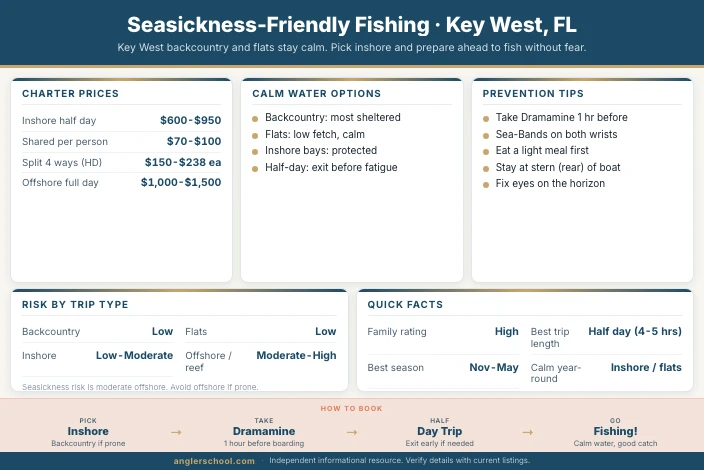
A private half-day split among four people works out to roughly $150 to $240 each. That’s more than a shared-boat ticket, but you get a captain focused on your group, full route flexibility, and the ability to pull into calmer water if conditions shift. For anyone with seasickness concerns, that flexibility matters.
Shared boats do exist in Key West, but most run reef or offshore routes, which are exactly the conditions you want to avoid. If budget is tight, a shared inshore trip is the exception to look for when booking. Confirm the route before paying.
Trip Length Guidance
A four or five hour half-day trip is almost always the right call for anyone prone to seasickness. Fatigue and dehydration worsen motion sickness, and both accumulate fast on the water. Getting off the boat before you hit that threshold is easier than recovering once you’re past it.
Full-day trips of eight to ten hours can work on inshore routes, but they’re a gamble if you don’t have prior experience with how your body handles extended time on the water. Start with a half-day trip first. If you feel fine at the end of it, you’ll have good information for booking a longer trip next time.
Morning departures also tend to be calmer than afternoon ones. Sea breeze typically builds through the day in the Keys, so a 7am start often means flatter water than a noon departure. When you book, ask about the departure time and what conditions typically look like at that hour.
Comfort Notes
The single most effective thing you can do is take medication before you board. Waiting until you feel sick is too late.
Medication options, by strength:
- Dimenhydrinate (Dramamine): over-the-counter, easy to find, causes drowsiness in some people. Take the night before and again the morning of your trip.
- Meclizine (Bonine): also over-the-counter, tends to cause less drowsiness than Dramamine. Take 12 hours before boarding.
- Scopolamine patch: prescription only. Apply behind the ear the evening before. Most effective option for people with a documented history of severe motion sickness. Requires a doctor visit to get.
- Ginger: ginger chews or ginger tea have real (though modest) anti-nausea effects for mild sufferers. Useful as a supplement to medication, not a replacement.
Sea-Bands (acupressure wristbands) work for some people and do nothing for others. They’re cheap and have no side effects, so they’re worth trying alongside medication.
On the boat, these habits help:
- Stay toward the stern (back of the boat) rather than the bow. The bow gets more motion on chop.
- Stay outside and watch the horizon. Below-deck cabins concentrate fumes and remove visual reference points.
- Avoid looking at your phone or reading. Fixed-screen focus worsens disorientation.
- Drink water steadily throughout the trip.
Key West’s flats and backcountry routes have low seasickness risk because the water is protected and shallow. You may not need medication at all for an inshore trip, but taking it anyway eliminates one variable from a trip that already has plenty of them.
What to Expect
On a flats or backcountry trip, you’ll meet your captain at a marina or boat ramp early in the morning. The boat will be a small skiff or bay boat, not a large vessel. These boats run at low speeds through calm, sheltered channels between mangroves and shallow bays. Motion is minimal.
The captain will set you up with rods and bait and explain the basics if your group is new. Flats fishing often involves the captain poling the boat quietly in very shallow water while everyone watches for fish. There’s little engine noise and very little wave exposure. It’s a different experience from anything offshore.
If you start feeling unwell despite precautions, tell the captain immediately. Captains have dealt with this before and will adjust the route or return early if needed. Trying to push through is usually counterproductive. The earlier you say something, the more options the captain has.
Offshore trips are a different situation entirely. On a reef or deep-sea charter, you’ll spend time on open water with real wave exposure. Swells can be two to four feet or higher on a normal day. If you’re genuinely seasick-prone and book offshore, take medication, but understand the risk is real.
Example Trip Scenarios
A nervous first-timer who always gets carsick. This person books a four-hour private inshore trip in April, takes Bonine the night before, eats a light breakfast, and gets on the water by 7am. The boat stays in calm backcountry channels the entire time. No significant motion. They catch snapper and snook and feel fine throughout. At the end of the trip, they feel confident enough to consider a longer inshore trip next visit.
A parent who gets seasick but wants to fish with their kids. The family of four books a private half-day flats trip. The parent takes a scopolamine patch the evening before (prescribed by their doctor before the trip). The kids are 8 and 11, both within the typical minimum age of 5. The captain focuses on easy targets like ladyfish and snapper that give kids fast action. The parent monitors how they feel but ends the trip feeling well.
A group of four adults where one person is seasick-prone. Three want to try offshore for mahi-mahi. One is uncertain. They split the difference by booking a private nearshore reef trip instead of a full offshore run. The reef is closer in, so the boat spends less time in open water. The seasick-prone person takes medication and manages fine. The group catches snapper and grouper. Everyone is satisfied.
Book This Trip
- Browse Calm-Water Charters Opens booking platform
- Browse Activity Tours Opens tour booking platform
Frequently Asked Questions
- What seasickness medication works best for a fishing trip in Key West?
- Meclizine (Bonine) and dimenhydrinate (Dramamine) are the most commonly used over-the-counter options. Bonine tends to cause less drowsiness. For people with severe seasickness history, a prescription scopolamine patch applied the night before is the most effective option. Take any medication before you board, not after symptoms start.
- What should I do if I start feeling sick during the trip?
- Tell the captain right away. Captains on inshore and backcountry trips can adjust routes, slow down, or return to the dock. On an offshore trip, options are more limited because you’re farther out, which is another reason to book inshore if you’re uncertain. Don’t try to push through nausea in silence. Early action gives the captain more choices.
- Should I tell the captain about my seasickness before the trip?
- Yes. Mention it when you book, not on the morning of departure. A captain who knows in advance can plan a route that avoids the choppiest water, choose a departure time that works with tidal conditions, and keep a bucket accessible without making it awkward. Most captains appreciate the heads-up.
- Are morning trips or afternoon trips better for people prone to seasickness?
- Morning trips are almost always better. Wind and wave action in the Keys typically build through the afternoon as the sea breeze kicks in. A 7am departure gives you flatter water and cooler temperatures. Afternoon trips are fine on calm days but add variability you don’t need if motion sickness is already a concern.
More Trips in Key West
Not sure this is the right trip for you? These pages cover related decisions:
- Inshore vs Offshore for Families in Key West: a side-by-side breakdown of what each water type involves and who handles each better.
- What to Book When It’s Windy in Key West: windy days raise chop and seasickness risk; this page covers what stays fishable.
- Family Fishing Charters in Key West: covers trip styles, ages, and comfort for groups with kids.
- Best Half-Day Fishing Charters in Key West: shorter trips are better for motion-sensitive anglers; this page covers what a half-day gets you.
Related Guides
Deeper reading on the decisions this page covers:
Back to the Key West fishing charters overview.