Inshore vs Offshore Fishing for Families in Key West
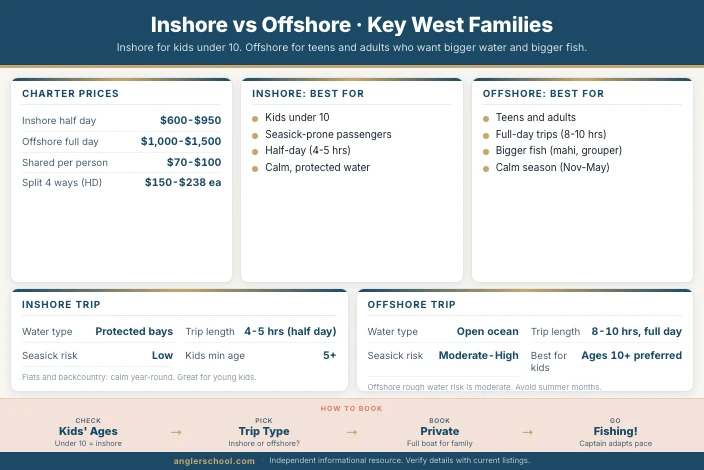
Who This Trip Is For
This page is for parents who don’t fish regularly and aren’t sure what “inshore” and “offshore” actually mean for a family trip. You’re trying to avoid booking something that makes a kid miserable on rough water, or conversely, undershooting by booking a flat-water trip when your teens wanted offshore action. Both mistakes are common and easy to avoid once you understand what each trip type actually involves.
What Inshore and Offshore Actually Mean
These terms describe where the boat goes, not just what species you catch.
Inshore fishing keeps the boat in protected water: the backcountry bay system behind the Keys, shallow flats, and mangrove channels. The water is calm most of the time. Trips typically run 4 to 5 hours. You’re fishing for tarpon, permit, bonefish, snook, and snapper. The boat is often a smaller skiff or center-console.
Offshore fishing means heading out past the reef line into open Atlantic or Gulf water. The boat is exposed to ocean swell and wind chop. Trips typically run 8 to 10 hours. Target species include mahi-mahi, grouper, and snapper. The motion is real, and anyone sensitive to seasickness will feel it.
Good Fit / Bad Fit
- Families with kids ages 5-9
- Anyone with seasickness history
- First-time fishing families
- Groups wanting a shorter 4-5 hour trip
- Families fishing during summer when afternoon storms build offshore
- Teens who want big-fish offshore action
- Groups where everyone handles rough water fine
- Anglers who specifically want mahi-mahi or deep-water grouper
- Families with no young kids and a full day to spend
- Groups visiting in calm spring months with stable offshore conditions
Budget Expectations
Inshore and offshore trips are priced by the boat, not by the type of water. A private half-day inshore trip costs roughly the same as a private half-day nearshore or reef trip. Full-day offshore charters cost more simply because they run longer.
Inshore / backcountry (half-day, private):
Split among four people, a half-day private inshore trip runs roughly $150 to $240 per person. That’s the most common family booking in Key West.
Offshore (full-day, private):
A full-day offshore trip split four ways comes to roughly $250 to $375 per person. You’re paying for more time on the water, more fuel, and a larger boat that can handle open-ocean conditions.
Shared boats (half-day, per person):
Shared boats are an option for budget-conscious adults, but they’re not a good fit for most families. You’re sharing deck space with strangers, the schedule is fixed, and fishing alongside children and random groups rarely works well. Private is worth the extra cost for families.
Trip Length Guidance
Half-day (4 to 5 hours) is right for any inshore trip, and it’s almost always the correct call for families with kids under 10. The productive fishing happens in the first few hours anyway. You’re back at the dock before kids get fatigued or sunburned.
Full-day (8 to 10 hours) is what offshore fishing requires because it takes time just to reach the fishing grounds past the reef. Don’t book a full-day offshore trip with kids under 8. The combination of a long run out, open-water exposure, and 8-plus hours on a boat is a lot for young children.
If your group is mixed ages and you want offshore fish, consider a half-day reef trip as a middle ground. The reef sits closer to shore than deep offshore grounds, offers some of the same species (snapper, grouper), and the water conditions are generally milder.
Comfort Notes
Seasickness risk is rated moderate in Key West. That number applies mainly to offshore and reef trips. Inshore backcountry fishing carries low risk because the water stays protected.
- Kids minimum age: Most private captains accept kids as young as 5 years old on inshore trips. Offshore, some captains prefer kids to be at least 8 due to the longer trip and rougher conditions. Confirm when you book.
- Shade: Flats skiffs have very little overhead cover. Offshore boats are usually larger and may have a cabin or T-top for shade. For inshore, bring hats, sun shirts, and reef-safe sunscreen.
- Bathrooms: Smaller inshore skiffs typically don’t have a head (boat toilet). Offshore vessels usually do. This matters for trips with young kids.
- Motion remedies: If anyone in your group is susceptible to seasickness and you still want offshore, take a non-drowsy antihistamine or seasickness patch the night before. Ask the captain for their recommendation when you book.
What to Expect
On an inshore trip, you’ll arrive at a smaller dock or marina early in the morning, meet the captain, and load onto a center-console or skiff. The captain provides rods, bait, and tackle. The run to the fishing grounds takes 15 to 30 minutes through calm bay water. You’ll anchor up or drift near structure, and the fishing is often close to the surface. Kids who have never held a fishing rod before tend to handle this style well because the action comes quickly and the environment is manageable.
On an offshore trip, the boat is larger, the dock may be different, and the run out to the fishing grounds takes 30 to 60 minutes in open water. You’ll feel the ocean swell on the way out. Once on the grounds, you’ll either anchor over a reef or drift and troll depending on the captain’s approach. The fish are larger on average, but the waits between action can also be longer.
Both trip types include the captain bringing all gear. Fishing licenses are covered by the boat’s charter license, so you don’t need to buy one separately.
Example Trip Scenarios
Scenario 1: A family with a 7-year-old who gets carsick. Motion sickness on the water tracks closely with how people respond in cars and planes. A child who gets carsick on winding roads is very likely to struggle on an offshore trip. Book a private inshore half-day. The calm backcountry water gives everyone the best chance of a good experience, and the species available (tarpon, snook, snapper) are genuinely exciting even if they’re not offshore targets.
Scenario 2: Two teens who watched offshore fishing videos and want mahi-mahi. A full-day private offshore charter is the right call if the teens (and any adults) have no motion sickness history. Mahi-mahi are caught offshore past the reef line, and a full day gives enough time to reach the grounds and fish properly. Book for spring or fall when offshore conditions in Key West are most stable. Avoid booking offshore in August or September when afternoon weather is unpredictable.
Scenario 3: A mixed group with a 6-year-old, a 14-year-old, and grandparents. This is the trickiest scenario and the most common one. The 6-year-old sets the limit here. Book a private inshore or reef half-day. The 14-year-old will still catch fish worth getting excited about, the young child won’t be miserable, and grandparents won’t spend four hours on rough water. Everyone gets on the water, and no one regrets the choice.
Book This Trip
- Browse Family Charters Opens booking platform
- Browse Activity Tours Opens tour booking platform
Frequently Asked Questions
- Can kids really catch fish on an inshore trip, or is offshore where the "real" fishing happens?
- Kids catch plenty of fish inshore in Key West. Tarpon and permit are trophy-level species that serious anglers specifically travel here to target. Snook and snapper are hard fighters too. Offshore fish are larger on average, but inshore fishing is not a consolation prize.
- What if my family wants to try offshore but one person is worried about seasickness?
- The sensitive person should take a non-drowsy antihistamine (like meclizine) the night before and the morning of the trip. Stay on deck in fresh air, focus on the horizon, and avoid going below or staring at a phone screen. If the concern is serious, the honest answer is to book inshore and remove the risk.
- Is a half-day inshore trip enough, or will we wish we booked longer?
- For families with kids, a half-day almost always feels like the right amount. Four to five hours on the water with young children is plenty. You can always book again tomorrow if you want more time, but you can’t undo a miserable full-day trip.
- When is the best time of year to fish inshore in Key West?
- March through June is peak inshore season, especially for tarpon. November and December are also excellent. August and September are the months to avoid due to storm weather and choppy conditions even in the backcountry.
More Trips in Key West
Not sure this is the right page for your question? These pages answer related decisions:
- Family Fishing Charters in Key West: Covers what a family-focused private charter looks like, what kids can realistically handle, and how to set expectations before you go.
- Seasickness-Friendly Fishing Trips in Key West: Goes deeper on how to pick a trip if motion sickness is a genuine concern for anyone in your group.
- What to Book When It’s Windy in Key West: When offshore conditions look rough, here’s which trip styles hold up and which ones to avoid.
- Best Fishing Charters for Kids in Key West: Focused specifically on younger kids (ages 5 to 11) and what makes a trip work for that age group.
Related Guides
Deeper reading on the decisions this page covers:
Back to the Key West fishing charters guide.