Inshore vs Offshore for Families in Fort Lauderdale
Who This Trip Is For
This page is for families trying to figure out which type of water to fish in Fort Lauderdale. Unlike Gulf Coast destinations with extensive shallow backcountry and bay systems, Fort Lauderdale’s inshore market is primarily canal and Intracoastal fishing. The offshore market is where most of the charter activity happens.
The decision matters because the two experiences are genuinely different.in comfort, in species, and in what kids are likely to remember.
Good Fit / Bad Fit
- Families with kids 8 to 14 who prefer offshore reef fishing
- groups comfortable with mild ocean swells
- families where the primary goal is catching variety and volume
- older kids who want to target mahi-mahi or sailfish
- visits during Dec to May when winter conditions are most manageable
- Families with kids under 7 who need flat calm water
- groups with a highly seasickness-prone member
- families expecting extensive calm inshore water like the Everglades or Tampa Bay estuary
- anyone who wants to target snook or redfish (not a strength here)
Budget Expectations
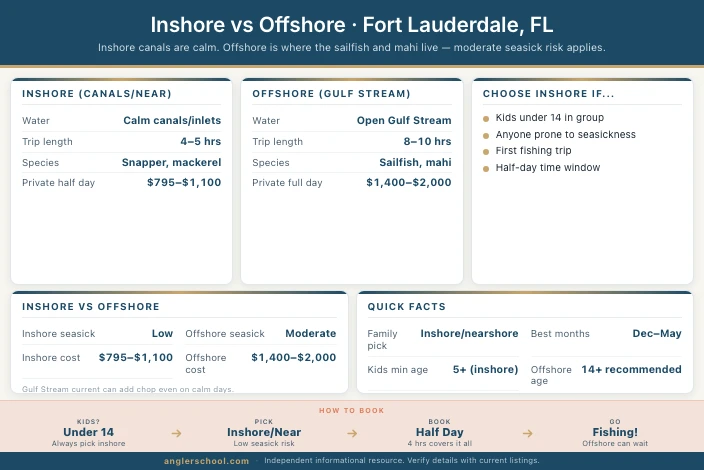
Both inshore and offshore private charters in Fort Lauderdale fall into the same general pricing tier because the local market doesn’t heavily discount for inshore style trips.
Canal inshore and offshore reef private charters in Fort Lauderdale fall into the same pricing tier.$795 to $1,100 for a half-day. The slight variation is that some canal trips can be done on smaller, less expensive boats.but the market is thin and you’ll need to specifically seek out inshore-focused captains.
Trip Length Guidance
For offshore reef trips with kids: half-day (4 to 5 hours) is the right format. Young kids run out of energy, and reef trips produce action in 30-minute stretches rather than requiring long offshore runs.
For inshore canal trips: these can be shorter.3 to 4 hours is common. The canal system is close, the fishing is casual, and there’s no transit time to the grounds.
Comfort Notes
Offshore reef (the common choice)
- Seasickness risk: Moderate. Open Atlantic swells are real, especially in winter. Kids who get carsick are at risk.
- Stability: Larger offshore boats are more stable than small inshore skiffs, but they still roll in chop.
- Distance from shore: Reef sits 2 to 6 miles offshore. You’re on the ocean, not in a protected bay.
- Species: Snapper, grouper, king mackerel, mahi-mahi (spring), sailfish (winter). High variety.
- Best for kids: Ages 8 and up with average motion tolerance
Inshore canal / Intracoastal
- Seasickness risk: Low. Protected water, minimal wave action.
- Stability: Small flat-bottom or bay boats in calm water.no rolling.
- Distance from shore: You’re in the canal or Intracoastal, never on open ocean.
- Species: Snook, jack, snapper, ladyfish. Less variety, smaller fish, but active and fun for kids.
- Best for kids: Any age, including kids under 8
What to Expect
Offshore reef trip: You depart from an inlet marina and run out to the reef. Kids can see the water color change from green to blue as you approach the Gulf Stream. The captain anchors or drifts over structure. Kids drop baited hooks and wait for bites. Most kids catch their first real saltwater fish on this style of trip.
Canal / inshore trip: You depart from an Intracoastal dock and work through the canal system or along mangrove edges if any exist nearby. The boat stays in flat, protected water. The captain targets snook, jack, and snapper in structure like docks, bridge pilings, and current breaks. Casting or light spinning gear is common.
The inshore trip looks more like “regular fishing” to kids. The offshore trip is more dramatic and produces bigger fish.
Example Scenarios
A family with an 8-year-old and a 5-year-old debates their options. The 5-year-old has a history of carsickness. They choose an inshore canal trip. The 5-year-old catches three small snook on light spinning gear and never gets sick. The 8-year-old catches more fish but wonders aloud about the big boats they see heading offshore.
A family of four with 11-year-old twins books a private reef half-day in January. Both twins catch their first ocean fish.yellowtail snapper. On the way back one twin spots a free-jumping sailfish and the captain circles back for a look. Nobody gets seasick. The family talks about coming back for an offshore trip in March.
A family of five arrives in Fort Lauderdale in August and asks about inshore options because they read the offshore conditions are rough in summer heat. The inshore canal trip is calm and produces steady action on small fish. They’re glad they asked.
Book This Trip
- Browse Family Charters Opens booking platform
- Browse Activity Tours Opens tour booking platform
Frequently Asked Questions
- Does Fort Lauderdale have good inshore fishing for families?
- Some, but it’s a limited market. The canals and Intracoastal hold snook, jack, and snapper. The fishing can be fun, especially for young kids who need calm water. But Fort Lauderdale’s dominant charter market is offshore.inshore-focused captains are fewer and harder to find.
- How far offshore is the reef in Fort Lauderdale?
- The reef system starts 2 to 3 miles offshore and extends out to 6 to 8 miles. The Gulf Stream edge sits roughly 4 to 7 miles out. These are short distances compared to Panhandle destinations, which is why half-day offshore trips are so practical here.
- What's the minimum age for offshore reef trips with kids?
- Most captains accept kids 6 and up on private charters. Some set the minimum at 8 for trips going farther offshore. Confirm with the captain when booking, and be honest about your child’s motion sensitivity.
- If my family gets seasick easily, should we skip Fort Lauderdale entirely?
- Not necessarily. Canal inshore trips are calm and accessible. If you’re set on Fort Lauderdale and worried about seasickness, see the seasickness-friendly trips page for specific guidance on managing risk.
More Trips in Fort Lauderdale
- Family Fishing Charters: Broader guide for groups with mixed ages
- Best Fishing Charters for Kids: Age-by-age guidance for younger children
- Seasickness-Friendly Fishing Trips: Specific strategies for managing open-ocean risk
- Best Beginner Fishing Charters: First-timer guidance on trip type and format
Related Guides
Deeper reading on the decisions this page covers:
Back to the Fort Lauderdale fishing charter guide.